
Why Free Music Is Not Free
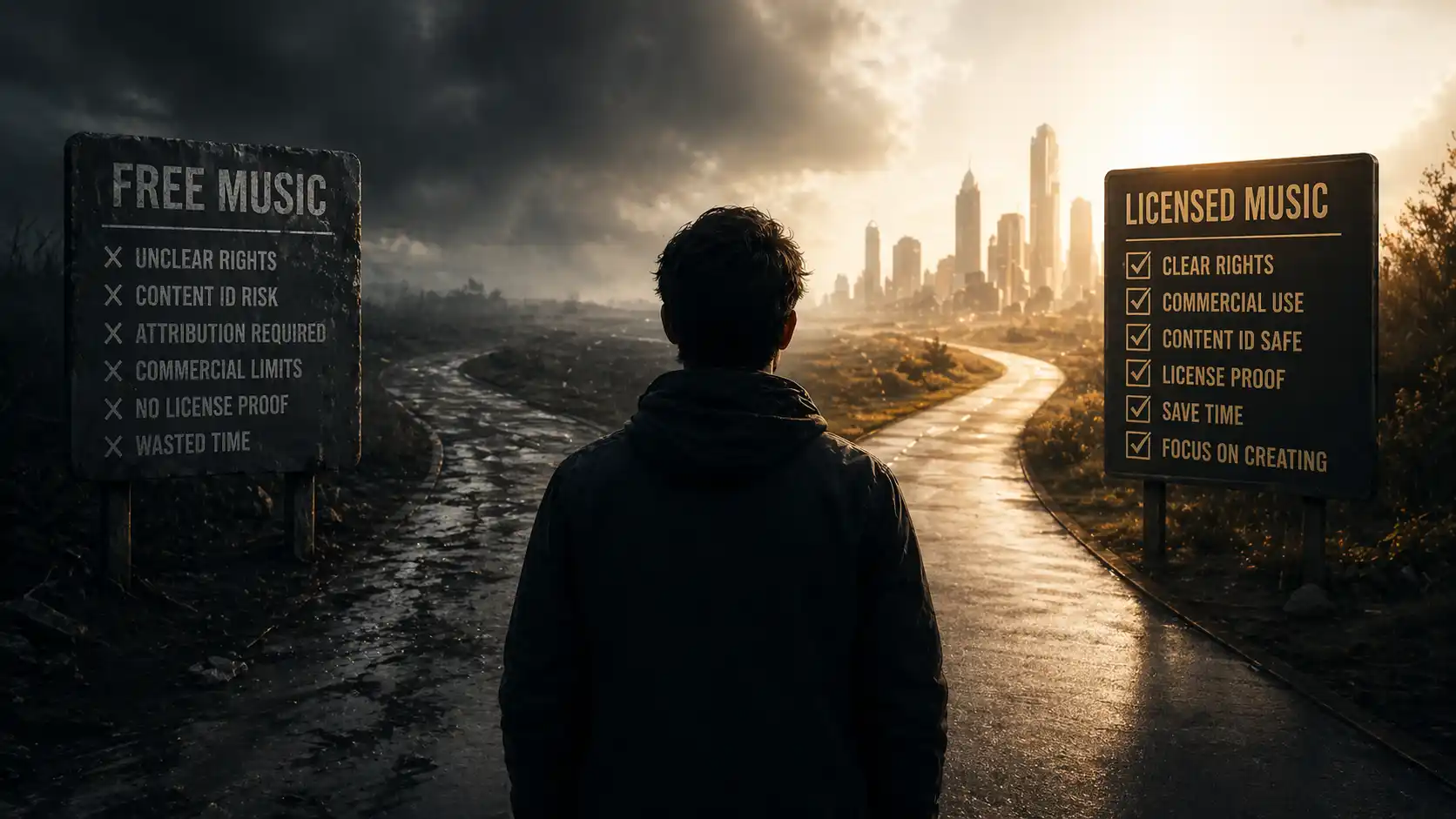
Quick answer: Free music can still cost you if the rights are unclear. The file may be free to download, but YouTube monetization, paid ads, client work, attribution, and Content ID can still create problems.
Use this guide before putting free music into a monetized upload, brand video, paid campaign, or client project.
| Risk | Why it matters | What to check |
|---|---|---|
| Attribution limits | Some free tracks require credit in a specific form. | Whether attribution is required and where it must appear |
| Commercial-use limits | Free does not always mean allowed for ads or clients. | Paid media, brand, and client-work rights |
| Content ID friction | A free track can still trigger claims or proof requests. | Claim policy and license documentation |
Free music feels like a practical shortcut when you are finishing a video and need something that works fast. You search for free music for videos, find a track that sounds usable, drop it into the timeline, and keep moving.
For a personal upload, that may be enough. For a client-facing edit, brand video, monetized YouTube channel, paid campaign, documentary, short film, product launch, or agency delivery, the download is only the first step. The real question is whether the music can safely follow the project wherever it needs to go.
A track can be free to download and still come with restrictions. It may require attribution. It may allow YouTube use but say nothing clear about paid ads. It may be fine for personal projects but not commercial work. It may be offered under a Creative Commons license that allows some uses and blocks others. It may come from a channel or website using loose wording like “copyright free” without giving you a license that would satisfy a client, platform, or brand team.
The file costs nothing. The uncertainty around the file can cost much more.
The License Matters More Than the Download Button
Music licensing is not about whether you can physically download an MP3 or WAV file. Anyone can download a file. The useful question is what you are allowed to do with it.
This is where a lot of creators get careless. They see “royalty-free,” “no copyright,” “free to use,” or “copyright-safe” and treat those phrases as if they mean the same thing. They do not.
Royalty-free does not always mean free. Free to download does not always mean free for commercial use. Copyright-safe on one platform does not automatically mean safe everywhere. A YouTube description saying “use this music in your videos” is not the same as a proper license document.
Usage Rights Decide Whether the Track Is Actually Usable
In practical work, the details matter: commercial use, monetization, client work, paid advertising, platform coverage, territory, duration, attribution, Content ID status, and proof of license. These details decide whether the track is actually usable once the project leaves your editing timeline.
Free music often gives you the asset first and makes you investigate the rights later. That is backward for paid or published work.
YouTube Use Is Only One Part of the Job
Many creators judge music by one standard: will it be okay on YouTube?
That question is useful, but too small for many real projects. A finished video may end up on YouTube, Instagram, TikTok, LinkedIn, a website, a landing page, a conference screen, a sales deck, a paid ad campaign, or a client’s internal archive. An agency might need to hand over the project files. A filmmaker might submit the work to festivals. A brand might ask for written proof that the music is cleared.
A track that works for one YouTube upload may not cover all of that.
Content ID Can Still Create a Delivery Problem
Even on YouTube, free music can create friction. Content ID claims are not always copyright strikes, but they can still affect a video by blocking it, monetizing it for the rights holder, or tracking viewership depending on the rights holder’s settings. For a casual upload, that may be annoying. For a scheduled launch, monetized channel, sponsor video, or client campaign, it can become a delivery problem.
The worst time to discover a licensing issue is after the video is approved.
Attribution Can Become a Production Problem
Some free music is legitimately useful because it is offered under clear attribution-based terms. For many YouTubers, adding credit in the description is manageable.
A paid ad does not always have a clean place for music attribution. A brand video may be embedded on a website with no visible credits. A corporate film may be played at an event. A product launch video may be used in several formats across multiple teams. An agency may not want third-party credit language attached to every usage. A client may simply ask, “Can we use this without attribution?”
If the license requires credit and the project cannot naturally include it, the free track is no longer convenient. It creates a delivery constraint.
Attribution Is Not Always Compatible With Commercial Delivery
This is not a moral argument against attribution. Musicians should be credited when the license requires it. The point is practical: some projects cannot absorb attribution rules cleanly, especially when the video is part of a commercial system.
Free Music Can Waste Expensive Editing Time
The hidden cost of free music is often not legal drama. It is time.
Editors know how easily a weak track damages a cut. The music affects pacing, transitions, emotion, voiceover space, perceived production value, and the client’s reaction to the whole piece. A track can sound acceptable on its own and still fail inside the edit.
Free libraries often force you to dig through too much material that is technically usable but creatively weak. You find a track that almost works, cut around it, send a version, then replace it after feedback because it feels generic, too busy, too cheap, too repetitive, or too distracting under dialogue.
A free track that takes two hours to find is not free in any useful business sense. A free track that weakens the edit is not free. A free track that creates another revision round is not free. Editors, creators, and agencies do not only need music that costs less. They need music that helps the project finish faster and land better.
Good Production Music Supports the Workflow
Production music earns its place when it supports the workflow: clear structure, usable builds, clean endings, emotional control, proper mix quality, and enough range to fit different scenes without forcing the edit to serve the track.
Cheap Music Can Make Expensive Visuals Feel Smaller
There is good free music online. There is also a lot of music that reveals its price immediately.
Sometimes the issue is the composition. Sometimes it is the mix. Sometimes the track has too much melody under voiceover, no useful edit points, weak dynamics, overused trailer percussion, thin strings, dated synths, or a loop that starts feeling repetitive after twenty seconds.
Viewers may not consciously analyze those problems, but they feel the mismatch. The image says premium. The music says template folder. That gap lowers the perceived value of the whole video.
This matters more in cinematic and brand work because music carries tone and status. A product film, campaign video, documentary sequence, or cinematic YouTube intro needs music that feels intentional. If the track sounds generic, the edit inherits that quality.
Free is acceptable when the project can tolerate compromise. Commercial work usually cannot.
Proof of License Is Part of the Asset
A useful music track is not just the audio file. It is the audio file plus the right to use it, plus proof of that right.
Proof matters when a platform claim appears, when a client asks for documentation, when a brand reviews usage rights, when an agency hands over final assets, or when a video is reused months later in a different campaign.
A proper license gives you something concrete to show. It answers basic questions: what track was licensed, who licensed it, what usage is covered, and where the music can be used.
Free music often leaves the proof messy. You may have a screenshot, a copied description, a download page, or a vague license note. That may be enough for low-risk personal content. It is weak for client-facing delivery.
In paid work, the person approving the video usually does not care that the track was free. They care whether the rights are clear enough to publish without embarrassment.
Late Music Problems Damage the Whole Delivery
Music issues tend to appear late because music is often chosen late. The video is approved, the export is ready, the client has a launch date, and then someone asks the obvious rights question nobody handled earlier.
Replacing music at that stage is painful. The cut may lose its rhythm. Sound effects need adjustment. Voiceover levels may change. Transitions feel different. Emotional beats no longer land in the same place. A simple licensing problem becomes an editing problem, then a scheduling problem, then a trust problem.
This is why experienced editors become less impressed by “free” over time. They have seen the cost move from the invoice into the workflow.
The Licensing Model Needs to Match the Job
The smarter move is to choose music that already fits the usage, the platform, the client, and the delivery path. That does not make every paid track good. It means the licensing model needs to match the job.
When Free Music Still Makes Sense
Free music is useful in the right context. It can work for personal uploads, tests, school projects, rough drafts, low-risk social posts, or videos where monetization and commercial usage are not important.
It can also work when the license is clear, the attribution requirement fits, and the creator understands the limits. YouTube’s own Audio Library, for example, can be useful for YouTube-first creators because it is built for that environment.
The mistake is treating free music as a universal solution. It is not. It is a context-dependent resource.
For commercial, brand, monetized, or client-facing work, the music should be judged by the full workflow: how long it takes to find, how well it edits, whether it fits the tone, whether the rights are clear, whether it can survive platform checks, and whether you can prove you are allowed to use it.
Licensed Music Reduces Unnecessary Risk
Licensed production music exists because professional workflows need fewer loose ends.
The value is not only better sound. It is clarity. You know what you are using, where it came from, and what permission you have. You are not building the project around a vague promise in a video description or a license page you hope you understood correctly.
For creators, editors, filmmakers, and agencies, that clarity saves time. It makes the edit easier to approve. It gives the client more confidence. It reduces the chance of a messy rights conversation after export.
If you need cinematic production music for a project, you can search, browse, and license tracks through the Epikton music store.
The practical benefit is simple: choose music that fits the tone of the work, license it properly, and keep the project moving without turning the music choice into a future problem.
The Real Cost Is Uncertainty
Free music is attractive because the first step feels easy. No checkout. No invoice. No license fee. Just download and edit.
Published work has more steps than that.
The music still has to survive monetization, client approval, commercial usage, platform systems, brand review, future reuse, and basic professional scrutiny. If it cannot do those things cleanly, the track was only free at the beginning.
For low-risk content, free music can be enough. For paid, public, or brand-connected work, uncertainty is expensive. Licensed production music is often the more rational choice because it removes avoidable doubt from a part of the process that already creates enough problems.
Quick FAQ
Is free music safe for YouTube?
Sometimes, but only if the license clearly covers YouTube, monetization, attribution, and Content ID handling.
Can free music be used in paid ads?
Not unless the license clearly allows commercial advertising. Many free tracks are limited to personal or platform-specific use.
What makes licensed music safer?
Licensed music gives clearer usage rights and proof you can show to platforms, clients, or brand teams.
If free music feels too uncertain for the project, use the search below to find licensed alternatives. Try tension, action, epic, hybrid, or horror, then check the rights before you edit.