
Updated: May 2026
Gameplay Trailer vs Cinematic Trailer: What Music Should Do in Each
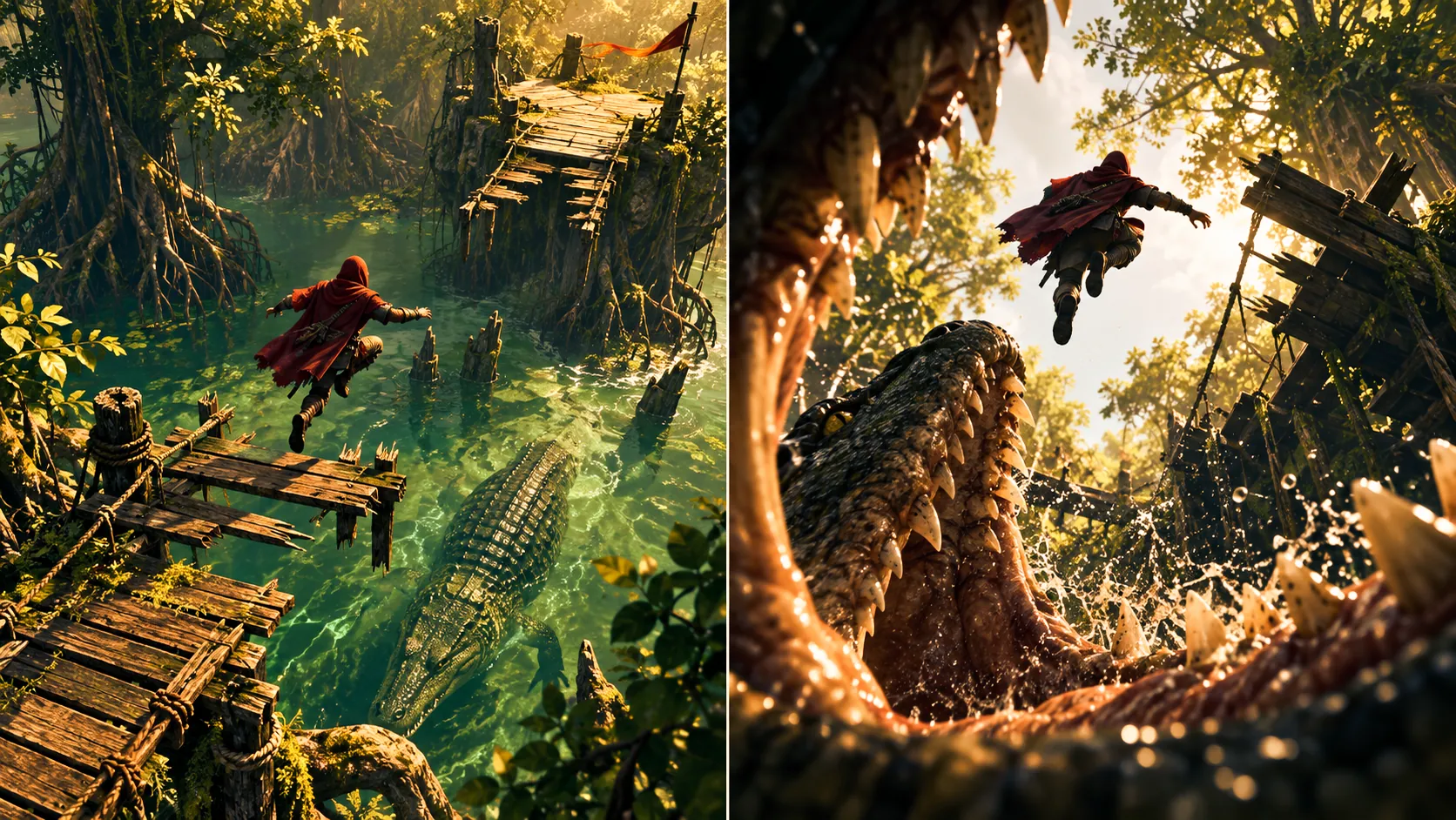
A gameplay trailer and a cinematic trailer can come from the same game, use the same world, and point toward the same launch.
The music still has a different job in each one.
A gameplay trailer has to make the game understandable. A cinematic trailer has to make the game feel worth caring about. When the track does the wrong job, the trailer can look polished and still leave the viewer unsure.
For indie teams, this distinction matters because one piece of music may end up carrying a Steam page trailer, a Kickstarter campaign video, a launch post, a festival submission, and social clips.
The safest choice is not always the biggest cue. It is the track structure that supports the exact footage in front of the viewer.
The Core Difference
A gameplay trailer is evidence.
It shows movement, combat readability, camera behavior, UI rhythm, level flow, crafting, driving, building, resource pressure, failures, wins, or whatever the player will actually do. The viewer is asking a practical question: “What is the game?” Music should help the edit answer that question faster.
A cinematic trailer is promise.
It sells world, threat, mystery, scale, character, mood, and emotional direction. The viewer is asking a different question: “Why should I care?” Music can take more narrative weight because the footage is usually designed around feeling rather than proof.
| Trailer type | Primary viewer question | Music should do | Music should avoid |
|---|---|---|---|
| Gameplay trailer | What do I actually do? | Create pulse, clarity, and edit points while leaving room for game audio. | Covering combat, UI, controls, or key mechanics with constant drama. |
| Cinematic trailer | Why does this world matter? | Build emotion, scale, dread, wonder, or momentum toward a reveal. | Starting too huge, flattening the arc, or promising a tone the game cannot support. |
| Hybrid trailer | What is the game and why should I care? | Separate proof beats from emotional beats so the viewer can follow both. | Letting story music blur the moment where gameplay needs to be read. |
Diagnose The Footage Before You Choose Music
Before searching for a track, watch the footage with no music and write down what it already communicates. This keeps you from using music as a cover for an unclear edit. A strong track can sharpen weak footage, but it cannot make hidden mechanics obvious if the shots do not show them.
- What must the viewer understand in the first 10 seconds? Genre, camera perspective, combat style, traversal, building, party size, tone, or one unusual mechanic?
- Where does the footage need silence or space? A weapon impact, monster sound, UI confirmation, voice line, puzzle solve, jump scare, or player reaction may need to lead.
- Which shots are proof and which shots are mood? Proof shots need clarity. Mood shots can tolerate more musical pressure.
- Does the edit escalate visually? If the footage stays similar, choose music with careful internal movement. If the footage already escalates hard, avoid a track that fights every cut.
- Is the ending a title card, release date, campaign ask, or store-page nudge? The final hit should match the action you want the viewer to take.
This diagnosis also helps if you are working with an editor, composer, publisher, or contractor.
Instead of saying “make it epic,” say, “The first half needs readable combat, the middle needs a feature montage, and the last 12 seconds need a cinematic release-date finish.” That is a music brief, not a mood wish. For a deeper template, use the guide on writing a trailer music brief.
Gameplay Trailer Music Has To Leave Room For Proof
Gameplay footage often contains several layers of information at once: enemy behavior, cooldowns, hit reactions, physics, camera shake, damage numbers, inventory choices, hazards, or pathfinding.
If the music is too dense, the trailer starts to feel like a music video placed over game capture instead of a focused preview of play.
Good gameplay trailer music usually gives the edit a steady spine.
Percussion, synth pulse, bass movement, restrained hybrid drums, ticking-clock tension, or a driving ostinato can work because they create forward motion without occupying every inch of attention. The track should make cuts feel intentional while leaving air for game sound and visual comprehension.
A practical gameplay structure might look like this: start with clean identity, cut quickly into the core mechanic, hold a steady pulse under readable play, lift the energy when new enemies or abilities appear, leave a half-beat for a surprising feature, then land the logo or wishlist card on a clear hit.
The music does not need to shout. It needs to organize the proof.
If the trailer includes real gameplay audio, treat it as evidence. Weapon cracks, footsteps, UI sounds, engine revs, monster calls, crowd reactions, and impact sounds tell the viewer that the game is tangible. Music should frame those sounds, not bury them. The trailer pacing guide is useful here because pacing is often where the music and footage either lock together or start arguing.
Cinematic Trailer Music Can Carry The Reveal
Cinematic footage can tolerate a larger musical role because the viewer is usually not trying to parse controls or systems. The track can suggest dread before the monster appears, scale before the city is revealed, or grief before the character speaks. It can create the emotional contract of the trailer.
That does not mean the music should be huge from the first frame.
Cinematic trailers still need contrast. A useful structure might begin with a texture, drone, low pulse, fragile motif, or distant percussion. The middle can widen as the world and conflict become clear. The final third can bring heavier drums, brass, synth pressure, strings, or impacts as the reveal lands.
Genre language matters more in cinematic trailers because the music often tells the viewer how to interpret the images. Horror may need restraint, dread, negative space, and ugly tension. Sci-fi may need electronic pressure, synthetic bass, processed percussion, or cold atmosphere. Action may need rhythm, impact, and forward drive. If you are comparing tone families, the guide to horror, sci-fi, and action promo music can help you name the lane before you search.
A cinematic trailer can also overpromise. If the game is a small tactical roguelite, a massive world-ending orchestral cue may make the campaign feel less honest. If the game is intimate, eerie, or systems-led, a smaller but sharper cue may create more trust than a track trying to inflate the project.
Choose The Track Structure Around The Footage
Choose the track after you know the footage shape. Gameplay trailers often need clean starts, readable midsections, and edit points that make mechanics easier to follow. Cinematic trailers often need a slower emotional build, bigger transitions, and a final peak that feels earned. Hybrid trailers need both, which means the track should have sections you can separate cleanly.
Search with the footage job in mind: gameplay clarity, cinematic build, readable combat, emotional reveal, and a store-page pulse are all better directions than simply looking for the loudest trailer cue.
Search Music
For a gameplay trailer, start from the proof. Cold open on one unmistakable mechanic, bring the pulse in under the first sequence, raise energy with enemy variety or system depth, let one feature breathe, then land the clearest montage and title card. The music should have obvious cut points so you can swap shots without making the edit feel broken.
Cinematic structure can move more slowly: atmosphere or motif, story image, first sign of threat, larger reveal, pressure build, title, and final sting.
Here the track can shape anticipation more strongly. The important question is whether the rise matches the sequence of reveals. If the track peaks before the trailer explains why the viewer should care, the ending can feel noisy instead of satisfying.
Hybrid trailers need more discipline, not less.
Let the cinematic opening establish tone, let gameplay sections become clearer and more rhythmic, then return to a stronger musical finish for the final promise. If the same musical density sits under every shot, the viewer may miss the difference between story atmosphere and actual play.
Steam And Kickstarter Need Different Cuts
Steam is a fast decision environment. Steam’s trailer guidance favors clear gameplay for the first listed trailer, which means your first Steam cut should not depend on a long musical intro. The music should help the opening feel alive, but the footage has to communicate quickly even if the viewer hears nothing.
So for Steam, favor tracks that start cleanly, establish rhythm fast, and support visible play. The first listed trailer should usually answer the basic question before the viewer scrolls: what is the game, what does the player do, and why does it look satisfying?
Kickstarter gives you a little more room.
A campaign video can carry creator story, development context, funding need, and emotional promise. The track may need to sit under voiceover, support proof-of-progress footage, and then lift into a final ask. A cinematic build can work well there, but only if it does not make the project feel bigger than the playable proof on the page.
The practical split is simple: Steam music should make the game readable quickly; Kickstarter music should make the project believable over a longer pitch.
If you use the same track for both, consider making different edits instead of forcing one trailer to solve every problem.
Licensing And Versioning Still Matter
A trailer track may travel farther than you expect. The same cue can appear on Steam, itch.io, YouTube, a Kickstarter page, a press kit, social clips, paid ads, devlogs, publisher decks, and launch emails. Before export day, check whether the license covers the actual places you plan to use the trailer. The guide on how to read a music license is a useful sanity check before a track becomes locked into the edit.
Also keep versions organized. A gameplay trailer may need a mix with more game audio, a shorter store-page cut, and a social crop. A cinematic trailer may need a clean version, a voiceover version, and a shorter reveal cut. Save the track title, license file, receipt, composer or catalog info, and final exports in one rights folder so the team can answer questions quickly.
A Practical Rule Before Export
Before you commit, watch the trailer twice. On the first pass, ask whether the footage is clearer because of the music. On the second pass, ask whether the emotion is stronger without becoming misleading. If either answer is no, the track may be good music and still not be the right trailer music.
Start with the job of the footage: proof, pulse, reveal, dread, scale, tension, or final lift. The best track is not the one that sounds most impressive in isolation. It is the one that makes the trailer’s purpose obvious.
The final rule: let gameplay music prove the game, and let cinematic music raise the stakes. When those jobs stay separate, the trailer feels more confident before the viewer knows why.